Sunday, September 18, 2016

3 Treaty of Frankfurt am Main ends Franco-Prussian War

http://www.history.com/this-day-in-history/treaty-of-frankfurt-am-main-ends-franco-prussian-war


///////////////////...


Treaty of Frankfurt am Main ends Franco-Prussian War

The humiliating defeat of Louis Napoleon’s Second Empire of France is made complete on May 10, 1871, when the Treaty of Frankfurt am Main is signed, ending the Franco-Prussian War and marking the decisive entry of a newly unified German state on the stage of European power politics, so long dominated by the great empires of England and France

At the root of the Franco-Prussian conflict was the desire of the ambitious statesman Prince Otto von Bismarck to unify the collection of German states under the control of the most powerful of them, his own Prussia. The event that immediately precipitated the war was the Bismarck-engineered bid by Prince Leopold, of the Prussian Hohenzollern royal family, for the throne of Spain, left empty after a revolution in 1868. Horrified by the idea of a Prussian-Spanish alliance, the French government of Louis Napoleon (or Napoleon III) blocked this idea and, determined to humiliate Prussia into subordination, insisted that the Prussian king, Wilhelm I, personally apologize to the French sovereign and promise that there be no further such attempts by the Hohenzollerns. Wilhelm refused, and subsequently authorized Bismarck to publish the French demands and his own rejection of them; the prince did so knowing such a move would precipitate a war, which he himself greatly desired in order to free Prussia completely from French influence.
Eager to regain prestige after numerous defeats abroad and reassert its military dominance on the European continent, France declared war on July 19, 1870. Unfortunately for the French, the states of southern Germany honored their treaties with mighty Prussia and immediately backed Wilhelm’s armies. Thus the Germans were able to marshal some 400,000 men, double the number of French troops, at the outset of the war. Under the supreme command of Wilhelm and guided by Count Helmuth von Moltke—known as Moltke The Elder, to distinguish him from his nephew, who would command German forces during World War I—three German armies cut a broad swath through France, gaining the upper hand almost from the beginning of the fighting.
The crucial battle of the war, fought around the town of Sedan in northern France, resulted in a crushing German victory, in which Napoleon III himself was captured. Upon learning of the emperor’s capture, Paris exploded into rebellion; the legislative assembly was dissolved, and France was declared a republic. Meanwhile, the Germans were closing in: by the end of September, they had captured Strasbourg and completely surrounded France’s capital city, which they subjected to merciless siege and bombardment for the next several months. On January 19, 1871, the French government was forced to open negotiations for surrender. A day earlier, in an added humiliation for France, the Bismarckian dream of unification was fulfilled, as Wilhelm I of Prussia was crowned emperor, or kaiser, of the new German state, in a ceremony that took place in the sumptuous Hall of Mirrors, at Paris’s Versailles palace.
By the terms of the final treaty, signed on May 10, 1871, at Frankfurt am Main, Germany annexed the French provinces of Alsace (excluding Belfort) and Lorraine; the French were also ordered to pay an indemnity of five billion francs. German troops occupied France until September 1873, when the amount had been paid in full. The Franco-Prussian War and the nearly three years of German occupation that followed marked the beginning of a growing enmity between anxious France, its influence and power in decline, and striving Germany, a technologically and industrially superior nation that by the first decade of the 20th century had built the most powerful land army on the European continent. In the summer of 1914, this rivalry would explode into full-scale global warfare, pitting France and the Allies against Germany and the Central Powers in the most devastating conflict the world had yet seen.


2 Unification of Germany

http://www.onthisday.com/europe/bismarck.php


Otto Von Bismarcks iron-man image and the unique personality was the crucial factor in the unification of Germany. His skill as a diplomat was unrivalled during his reign as chancellor of Prussia and Germany. The mastery he showed in foreign policy was such that he was able to outwit all other powers and make their leaders look pathetic.

Bismarck inherited the ideas and political principles of the Junker class of which he was born into. Bismarcks father was loyal to the Prussian crown and narrow minded in his outlook, except for his choice in wife. Whilhelmine, Bismarcks mother was from a middle class background and cultured. She passed onto her son her love of music and literature. He was later to become a master in many fields of knowledge through his interest in reading. Bismarck disliked his mother but revered his father. From his family Bismarck gained a highly autocratic, intensively conservative and monarchical outlook on life. He also became a Prussian patriot. Bismarck born into nobility accepted its beliefs as his own.
Bismarck had a mostly typical Junker education that he used to gain employment in the Prussian Civil Service. Bismarck started his education in Berlin at the spartan boarding school Plenum Academy where religious and physical exercises dominated. He later transferred to the Gymnasium (high school) at which he learnt foreign languages. In 1832 he entered the University of Gottingen and studied law. Gottingen was one of the centres of German liberalism and a strange choice for Bismarck. He rarely attended lectures preferring instead to drink, duel and womanise. A dabbling in Liberal literature and German philosophy took up the rest of his time. Liberalism had no appeal to him so he changed universities to the University of Berlin where he passed in 1835. As Bismarck himself put it "mob interference with political authority conflicted with my Prussian upbringing and I returned to Berlin with less liberal opinions than when I quitted it." After reluctantly serving his compulsory year in the military as a Gardejager (sharpshooter) Bismarck entered the Prussian Civil Service. He disliked following other people's policy and left the Civil Service in 1839 to look after his estates. Bismarck lived a restless life on his estates but did manage to marry Johanna von Puttkammer. His first political break came in 1847 when he was appointed in place of an ill man to the United Diet. It was in the United Diet that Bismarck emerged as a defender of the monarchy and a Junker reactionary. Bismarcks reactionary stance and anti liberalism endeared him to the Prussian government. In 1851 he was appointed Prussian representative to the restored German Bund as a reward for his stance in the United Diet. During his time in the Bund Bismarck formed an anti-Austrian view point. He insisted on equal status for Prussia and Austria and emphasised it by smoking at the Bund. This violated diplomatic procedure as only Austria previously smoked. Regent William sidelined Bismarck in 1859 for his anti Austrian views and sent him to St Petersburg. As Ambassador in the Russian capital he formed a great respect for Russian strength. In 1862 he was made Ambassador in Paris. Bismarcks views and attitudes saw him hold a series of political posts.
The constitutional crisis brought Bismarck to power. William I now King of Prussia was by training a soldier and was convinced the brief mobilisation of 1859 had revealed inadequacies in the Prussian military. In collaboration with the Minister of War von Roon and the Chief of General Staff Moltke William presented proposals to the Prussian parliament to increase the size of the army and various other army reforms. The Liberals dominated the parliament and were determined to exercise one of the few powers that the constitution of 1849-50 had given the parliament. That is control over the budget. The expansion of the army naturally involved considerable expenditure that would entail an increase in taxation of 1.5 million pounds a year. The Liberals were opposed to this since they would have to pay the extra taxation. Also another of the reforms was to consolidate the Landwehr a small middle class militia into the Junker dominated Prussian army. By an overwhelming majority the proposed army reforms were rejected and a class struggle ensued. On the verge of abdication William turned to Bismarck for help whose appointment meant no compromise. Von Roon sent Bismarck the famous telegram "Delay is dangerous. Hurray." This was the opportunity Bismarck had been waiting for and he acted quickly making William tear up his abdication document. He drove liberals from office, gagged the press and encouraged William to create the new units by collecting existing taxation. This is an example of Bismarcks Realpolitiks, the pursuing of realistic goals by any available method instead of the pursuit of an ideology. Bismarck never wanted to have enemies for long and hoped to pacify the Liberals with foreign policy achievement notably the unification of Germany. With an expanded army Bismarck resolved to achieve unification with "iron and blood" rather than with Liberal methods. The Liberals rejection of the army reforms forced William to play his final card, the appointment of Bismarck as Minister-President of Prussia.
The Schleswig Holstein war was manipulated by Bismarck to the advantage of Prussia. Schleswig and Holstein were populated by Germans and had for centuries been ruled by the Danish King. In 1863 the Danes formed a new constitution intended to incorporate Schleswig and Holstein into Denmark. Nationalist sentiment erupted all over Germany and Bismarck saw his first great opportunity. The Confederation Diet voted to send troops to Holstein in support of the German prince Augustenburg. Bismarck did not want to be seen as the aggressor so sent Saxon and Hanoverian. Troops. From the outset it was clear Bismarck wanted to annex both duchies, to do this meant war with Denmark. He set about ensuring that no one could help Denmark. Russia was sympathetic due to Prussia's help during the Polish rebellion of 1863, France was bribed by hints of compensation in the Rhineland and Austria was persuaded to form an alliance with Prussia. Britain stood firmly behind Denmark and Palmerston stated "if Denmark had to fight she would not fight alone." Bismarck demanded Denmark submit the matter to a European congress, Denmark encouraged by Britain refused. He correctly called Palmerston's bluff and together with Austria invaded Denmark in February 1864. Isolated the Danes had no chance and were soundly beaten. Bismarcks secondary reason for attacking Denmark was to gain support from nationalists and Liberals at home. This he achieved and his heavy handedness over the army reforms was forgiven and forgotten. Prussia and Austria initially tried a joint rule of the duchies but this fell apart by deliberate design of Bismarck who had ordered the annexation of Kiel. The Treaty of Gastein in 1865 let Austria administer Holstein and Prussia Schleswig. Bismarck now new he could pick a fight with Austria when the need arose. Using diplomatic skill Bismarck ensured Denmark's defeat and laid the foundations of war with Austria.

1 B-1 European wars and the balance of power: 1865–1866


File:Otto von Bismarck.JPG

Otto von Bismarck, Chancellor of Prussia


European wars and the balance of power: 1865–1866[edit]

In October 1865, Napoleon III, ruler of France, met with Prussian Prime Minister Otto von Bismarck in Biarritz, France. It was there that the two men struck a deal— France would not get involved in any future actions between Prussia and Austria or ally herself with Austria if Prussia did not allow Austria to claim Venetia. When Austria and Prussia met in May 1866, Bismarck honored the agreement made in Biarritz the previous year and refused to allow Austria to have Venetia. Austria then attempted to guarantee Italy Venetia if they remained neutral, but the two nations were unable to agree on a suitable arrangement as an alliance formed earlier in the year bound Italy to Prussia. Napoleon III then committed a serious blunder by agreeing with Austria in a treaty to accept Venetia by allowing Austria to go to war with Prussia, a move which violated the agreement Napoleon had made with Bismarck


After Prussia emerged victorious over the Austrian army at the Battle of Königgrätz (also known as Sadowa or Sadová) in the Austro-Prussian War of 1866, negotiations were being held between Austria and Prussia in July and August of that year.[5] It was during that period that Napoleon III first discovered that a bladder stone was causing him great pains, created from gonorrheal infection.[6] His condition was so bad during those negotiations that he was forced to retire to Vichy to recuperate, removing himself from Paris. Although the emperor favored neutrality as to not upset events, certain members of his circle thought it was an unwise move, considering the opportunity to prevent Prussia from becoming too strong. One of these men, foreign minister Édouard Drouyn de Lhuys, convinced the emperor to plant 80,000 men on the eastern border to convince Wilhelm I to maintain the balance of power in Europe. Despite this important victory, de Lhuys was subverted by several other ministers, and Napoleon III changed his mind, reverting to a position of neutrality. This change of heart would end up causing de Lhuys to ultimately lose his position.[7] Napoleon III's wife Empress Eugénie, who took an active part throughout his rule, referred to this time much later as "the critical date, the Empire's fatal date; it was during these months of July and August that our fate was sealed! Of all that period, there is not a single fact, not a single detail that has not remained in my mind."[8]
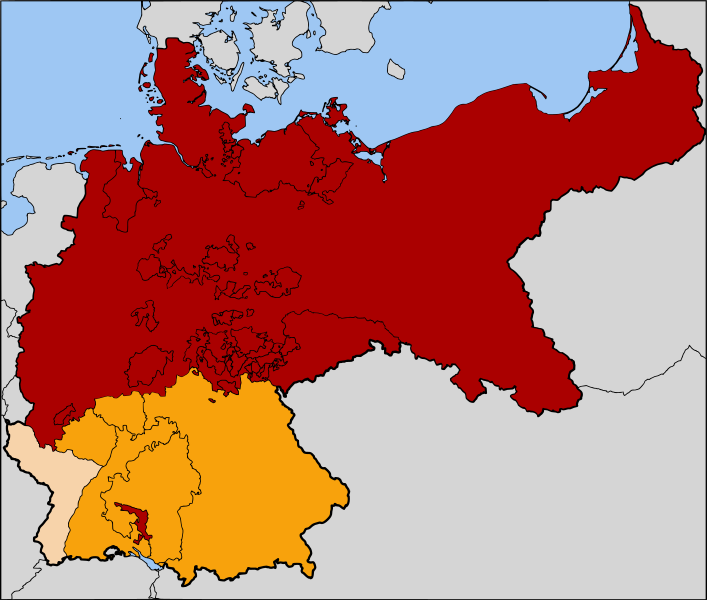
Franz Joseph of Austria accepted Bismarck's terms under the Peace of Prague. Using this to his advantage, Bismarck declared the German Confederation of 1815 null and void, and created a new network of states under Prussian control. Frankfurt-am-MainHannoverHesse-Kassel (or Hesse-Cassel), HolsteinNassau, and Schleswigwere annexed outright while Hesse-DarmstadtMecklenburgSaxony, the Thuringian duchies, as well as the cities of BremenHamburg, and Lübeck were combined into a new North German Confederation that governed nominally and was actually controlled by Prussia herself.

Bismarck was approached soon after the end of the war by Napoleon III's ambassador to Prussia, Vincent Benedetti. Benedetti brought with him a secret proposal by Napoleon III that France would approve of Bismarck's acquisition of the northern German states and their control over the southern German states if Prussia remained neutral while France annexed Belgium and Luxembourg. France had earlier guaranteed the independence of Belgium in the Treaty of London in 1839 as an "independent and perpetually neutral state", making the proposal a tacit agreement to break their promise. Bismarck was very surprised since he had already gained a powerful position in Europe by the armistice, and called Napoleon III's request among others later "like 'an innkeeper's bill' or a waiter asking for 'a tip'." He asked Benedetti to provide the proposal in writing, and the ambassador obliged his request. This document was to be important to Bismarck later on, to great effect.[10]
The true views of Napoleon III on the subject of the balance of power in Europe can be found in a state circular handed to every diplomatic representative for France. In this paper dated September 1, 1866, the emperor saw the future of Europe after the Peace of Prague in this manner:
"Policy should rise superior to the narrow and mean prejudices of a former age. The Emperor does not believe that the greatness of a country depends upon the weakness of the nations which surround it, and he sees a true equilibrium only in the satisfied aspirations of the nations of Europe. In this, he is faithful to old convictions and to the traditions of his race. Napoleon I foresaw the changes which are now taking place on the continent of Europe. He had sown the seeds of new nationalities: in the Peninsula, when he created the Kingdom of Italy; and in Germany, when he abolished two hundred and fifty three separate states

////////////////

1-C Franco Prussian War


http://history-world.org/franco_prussian_war.htm


Events, Franco-prussian War 1870 - 1871, Siege Of Paris, 19.9. 1870 


///////////////////////
Franco Prussian War

The Franco-Prussian War, was a war in 1870-1871 lost by France to the German states under the leadership of Prussia. The underlying causes of the conflict were the determination of the Prussian statesman Prince Otto Edward Leopold von Bismarck to unify Germany under Prussian control and, as a step toward this goal, to eliminate French influence over Germany. On the other hand, Napoleon III, emperor of France from 1852 to 1870, sought to regain both in France and abroad the prestige lost as a result of numerous diplomatic reverses, particularly those suffered at the hands of Prussia in the Austro-Prussian War of 1866. In addition, the military strength of Prussia, as revealed in the war with Austria, constituted a threat to French dominance on the continent of Europe.

INITIATING INCIDENTS

The event directly precipitating the Franco-Prussian War was the candidacy of Leopold, prince of Hohenzollern-Sigmaringen, for the throne of Spain, rendered vacant by the Spanish revolution of 1868. Leopold had accepted the candidacy under persuasion from Bismarck. The French government, alarmed at the possibility of a Prusso-Spanish alliance resulting from the occupancy of the Spanish throne by a member of the Hohenzollern dynastic family, threatened Prussia with war if Leopold's candidacy was not withdrawn. The French ambassador to the Prussian court, Comte Vincente Benedetti, was dispatched to Ems, a spa in northwestern Germany being visited by William I, king of Prussia. Benedetti had been instructed to demand that the Prussian monarch order Prince Leopold to withdraw his candidacy. William, although angered, gave Benedetti permission to communicate directly with Leopold by telegraph. Leopold could not be reached, but his father, Prince Charles Anthony, wired a retraction of the candidacy in the name of his son.

he government of Napoleon III, still not content, was determined to humiliate Prussia, even at the cost of war. Antoine Agénor Alfred, duc de Gramont, the French foreign minister, demanded that William submit a personal letter of apology to Napoleon III and a guarantee that the Hohenzollern candidacy would never be renewed. In an interview with Benedetti at Ems, the Prussian king rejected the French demands. The same day, Bismarck obtained William's authorization to publish the French demands and the Prussian rejection contained in what was known as the Ems Dispatch. Bismarck edited the document in a manner calculated to aggravate the resentment of the French and the Germans. The Prussian statesman realized that this move would in all probability precipitate war, but he knew that Prussia was prepared, and he counted on the psychological effect of a French declaration of war to rally the south German states to Prussia's cause, thus accomplishing the final phase in the unification of Germany.

THE WAR BEGINS  
On July 19, 1870, France declared war on Prussia. The south German states, in fulfillment of their treaties with Prussia, immediately joined King William in a common front against France. The French were only able to mobilize about 200,000 troops; the Germans, however, quickly marshaled an army of about 400,000 men. All German forces were under the supreme command of William, with the great strategist Helmuth Karl Bernhard, Graf von Moltke, as his chief of staff. Three German armies drove into France, led, respectively, by General Karl Friedrich von Steinmetz, Prince Frederick Charles, and Crown Prince Frederick William, later Frederick III of Prussia and emperor of Germany. The first engagement, a minor skirmish, was won by the French on August 2, when they drove a small Prussian detachment from the city of Saarbrücken, near the border between France and Germany. In the major battles at Weissenburg (August 4), at Wörth (August 6), and at Spichern (August 6), however, the French under Marie Edmé Patrice Maurice, comte de MacMahon were defeated. MacMahon was ordered to fall back on Châlons. Achille François Bazaine, in command of all French troops east of the city of Metz, was directed to maintain his positions. Metz itself was to be held at all costs. These orders split the French forces, which were unable thereafter to regain their unity or freedom of action. On August 12 the French emperor handed the supreme command over to Bazaine, who was badly beaten in the great battles of Vionville (August 15) and Gravelotte (August 18), and forced into Metz. There he was besieged by two German armies. MacMahon then was ordered to relieve Metz. On August 30 the Germans surprised and defeated MacMahon's leading corps at Beaumont, whereupon he decided to withdraw his army to the town of Sedan.


BATTLE OF SEDAN AND CAPTURE OF NAPOLEON III
The decisive battle of the war opened in Sedan on the morning of September 1, 1870 (see Sedan, Battle of). At about 7:00 AM MacMahon was severely wounded, and an hour and a half later General Emmanuel Félix de Wimpffen received the chief command. The battle continued until 4:15 PM, when Napoleon, who meanwhile had arrived in Sedan, resumed command. Recognizing the hopelessness of the situation, he ordered the white flag to be hoisted. Terms of surrender were negotiated during the night, and on the following day Napoleon, together with 83,000 troops, surrendered to the Germans.


Upon receiving intelligence of the capture of the French emperor, Paris rose in rebellion, the Legislative Assembly was dissolved, and France was proclaimed a republic. Before the close of September, Strasbourg, one of the last points at which the French had hoped to stem the German advance, capitulated, and Paris was completely surrounded. On October 7 the minister of the new French government, Léon Gambetta, made a dramatic escape from Paris by balloon, and with his chief assistant, Charles Louis de Saulces de Freycinet, established a provisional capital in the city of Tours. From there they led the organization and equipment of 36 military divisions. The efforts of these troops proved unavailing, however, and they were at length driven into Switzerland, where they were disarmed and interned.

SIEGE OF PARIS, FRENCH CAPITULATION, AND GERMAN OCCUPATION
On October 27 Marshal Bazaine surrendered at Metz with 173,000 men. Paris, meanwhile, was subjected to siege and bombardment. Its citizens, attempting to stave off the enemy with crude and makeshift weapons, and reduced to eating cats, dogs, and even rats, were at length compelled, on January 19, 1871, to open negotiations for surrender.
A day earlier, January 18, an event had occurred that represented the culmination of Bismarck's unremitting efforts for the unification of Germany. William I, the Prussian king, was crowned emperor of Germany in the Hall of Mirrors at Versailles. The formal capitulation of Paris took place on January 28, following which an armistice of three weeks was arranged. A French national assembly, elected to negotiate the peace, convened at Bordeaux on February 13 and chose Adolphe Thiers as the first president of the Third Republic. In March Parisians broke out in revolt of the new assembly and organized a revolutionary government known as the Commune of Paris (seeCommune of Paris, 1871). Opposing the armistice, they fought bitterly against government troops sent by Thiers to suppress the revolt. The ensuing civil war lasted until May, when the revolutionaries surrendered.
The Treaty of Frankfurt, signed on May 10, 1871, ended the war between France and Germany. The treaty provided that the French province of Alsace (excepting Belfort) and part of Lorraine, including Metz, were to be ceded to the German Empire, and that France was to pay a war indemnity of 5 billion gold francs ($1 billion), submitting to occupation by German troops until the amount was rendered in full. This heavy obligation was discharged in September 1873, and during the same month, after an occupation of almost three years, France was at last freed of German soldiers.


1B-2 Battle of Königgrätz


File:Battle of Koniggratz.png


File:The Battle of Königgrätz.jpg

.............

Battle of Königgrätz


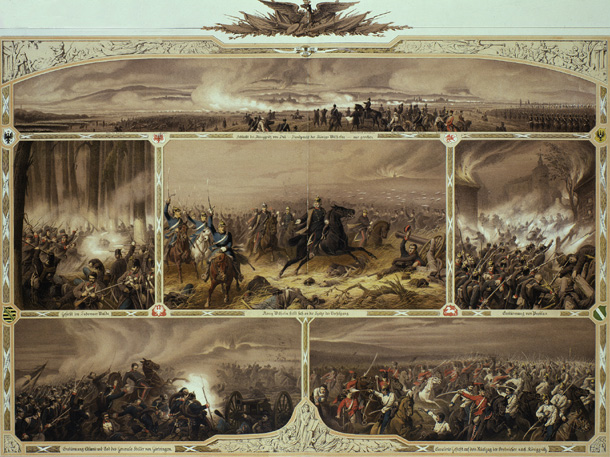
he Battle of Königgrätz (GermanSchlacht bei Königgrätz), also known as the Battle of SadowaSadová, or Hradec Králové, was the decisive battle of the Austro-Prussian War, in which the Kingdom of Prussia defeated the Austrian Empire. Taking place near Königgrätz (Hradec Králové) and Sadowa (Sadová) in Bohemia on 3 July 1866, it was an example of battlefield concentration, a convergence of multiple units at the same location to trap and/or destroy an enemy force between them

Preliminary campaign[edit]

At the outset of the war in June, the Prussian armies were gathered along the Prussian border: the Army of the Elbe under Karl Herwarth von Bittenfeld at Torgau, the First Army under Prince Friedrich Karl of Prussia between Senftenberg and Görlitz, and the Second Army under Crown Prince Friedrich in Silesia west of Neiße (Nysa). The Austrian army under Ludwig von Benedek was concentrated at Olmütz (Olomouc). The campaign began with Herwath von Bittenfeld's advance to Dresden in the Kingdom of Saxony, where he easily defeated the Saxon army of 23,000 and joined with the First Army.
The reluctant Austrian commander Benedek had moved his troops out of their staging point at Olmütz only on 18 June, moving north in three parallel columns with the I Corps protecting the right flank. The Austrians took up positions at the fortress Josefstadt and the mountain passes from Saxony and Silesia.[2]
On 22 June, Prussia's Chief of the General Staff, Helmuth von Moltke, ordered both armies under his command to Jitschin (Jičín) near the Austrian positions, a daring maneuver undertaken to limit the war's duration despite the risk of one army being overtaken en route.
Fortunately for Prussia, Benedek was indecisive and failed to use his superior numbers to eliminate the Prussian armies individually.[3] Initially, the Austrians were pressed back everywhere except at Trautenau (Trutnov), where they bested the Prussians despite great losses to their own forces. By 29 June, Prince Friedrich Karl had reached Jitschin and inflicted a severe defeat on the Austrian I Corps under General Clam-Gallas.[4]The Crown Prince had reached Königinhof (Dvůr Králové) despite stiff resistance.
On 30 June, Friedrich Karl's First Army advanced to within one day's march of the Second Army. However, for the next two days the Prussian cavalry lost sight of the Austrians entirely, although Moltke's guess as to their actions — a retreat to the Elbe River — proved correct.

Eve of the battle[edit]

Dismayed by his losses, Benedek had ordered a withdrawal and urgently requested that Emperor Franz Josef make peace as the only way to save the army from a "catastrophe".[4] When this was refused, and an ambiguous last sentence of the imperial telegram was interpreted as ordering a final stand, Benedek drew his Austrians up against the Elbe between Sadowa and Königgrätz.[4]
The Prussians finally sighted the Austrians on the eve of 2 July near Sadowa, and Frederick Karl planned to attack the next morning. Moltke ordered the Crown Prince Frederick to join forces with the other two armies at the point where the Austrians were assembled, but the telegraph lines to the Second Army's positions were out, necessitating the dispatch of two mounted officers at midnight to ride the twenty miles' distance in time. They arrived at 4 a.m. The Crown Prince's Chief of Staff, Leonhard von Blumenthal, an able logistician, immediately reorganised Second Army's route plan

The Austrian army of 215,000 faced the Prussian Army of the Elbe (39,000) and First Army (85,000) on 3 July. The Austrian infantry was partially fortified and supported by cavalry in the rear and artillery units with firing range across hilly, wooded terrain. The battle began at dawn in subsiding rain and mist as Prussia took its position west of the Bystřice River. Shortly before 8 a.m., the Austrian artillery opened fire, pinning down the Prussian right flank under Herwarth von Bittenfeld. The Saxons on the Austrian left fell back in good order, and proceeded to rain down fire on the advancing Prussian right from higher ground. Herwarth von Bittenfeld hesitated to order a full attack, and instead the advance guard of seven battalions, under Brig. General von Schöler pulled back to the river around 10:00 and took a defensive stance.
The Prussian center, with the Prussian 7th Division under General Eduard Friedrich Karl von Fransecky, having secured the Prussian rear earlier, led the advance into Swiep Forest, where it was met by two Austrian corps. The 7th Division had to both clear out the forest, and cover the Prussian left until the Second Army, under the crown prince, arrived. The Prussians methodically cleared the villages of Austrian defenders. King Wilhelm I of Prussia ordered the First Army across the river to support Fransecky. Sadowa was captured, but a fierce battle ensued in a nearby forest. The Austrian artillery held off the Prussians by firing into the smoke of the Prussian advance. The Prussians were slowed, and although the river was easy to wade, transporting artillery across it was extremely difficult. The Prussian attack was halted as the advancing Prussian 8th and 4th Divisions were cut down by the Austrian artillery as soon as they emerged from the smoke. However, the Austrian leader, Benedek, refused to call for a cavalry charge which later commentators have argued might have won the battle. Reserve units were deployed at noon, but the outcome of the battle was still uncertain and Prussian commanders anxiously waited for the crown prince.


1 B Causes of the Franco-Prussian War


File:Map-NDB.svg

...................

Causes of the Franco-Prussian War


he causes of the Franco-Prussian War are deeply rooted in the events surrounding the German unification. In the aftermath of the Austro-Prussian War(1866), Prussia had annexed numerous territories and formed the North German Confederation. This new power destabilized the European balance of powerestablished by the Congress of Vienna (1815) after the Napoleonic Wars. Prussia then turned its attention towards the south of Germany, where it sought to expand its influence.

France was strongly opposed to the annexation of the Southern German States (BavariaWurttembergBaden and Hesse), which would have created a too powerful a country next to its border. In Prussia, a war against France was deemed necessary to arouse German nationalism in those States that would allow the unification of a great German empire. This aim was epitomized by Prussian Chancellor Otto von Bismarck's quote: "I knew that a Franco-Prussian War must take place before a united Germany was formed."[1] Bismarck also knew that France should be the aggressor in the conflict to bring the Southern German States to side with Prussia, hence giving Germans numerical superiority.[2]
The immediate cause of the war resided in the candidacy of a Prussian prince to the throne of Spain, France feared encirclement by an alliance between Prussia and Spain. The Hohenzollern prince's candidacy was withdrawn under French diplomatic pressure, but Otto von Bismarck goaded the French into declaring war by altering a telegram sent by William I. Releasing the Ems Telegram to the public, Bismarck made it sound as if the king had treated the French envoy in a demeaning fashion. Six days later, France declared war on Prussia and Southern German States immediately sided with Prussia.[2]
French Emperor Napoleon III and Prime Minister Émile Ollivier's eagerness to relieve France from internal political convulsions also contributed to France's declaration of war on Prussia.


1 Hohenzollern dynasty

https://www.britannica.com/topic/Hohenzollern-dynasty


hOhenzollern dynastydynasty prominent in European history, chiefly as the ruling house of Brandenburg-Prussia (1415–1918) and of imperial Germany (1871–1918). It takes its name from a castle in Swabia first mentioned as Zolorin or Zolre (the modern Hohenzollern, south of Tübingen, in the Land Baden-Württemberg). Burchard I, the first recorded ancestor of the dynasty, was count of Zollern in the 11th century. In the third and fourth generation from him two lines were formed: that of Zollern-Hohenberg, extinct in all its branches by 1486, and that of the burgraves of Nürnberg, from which all the branches surviving into modern times derived

Frederick III of Zollern (d. c. 1200), husband of the heiress of the former burgraves of Nürnberg, himself became burgrave in 1192 as Frederick I. Between his two sons, Conrad and Frederick, the first dynastic division of lasting consequence took place: that between the line later known as Franconian (burgraves of Nürnberg, later electors of Brandenburg, kings inPrussia, kings of Prussia, German emperors) and the Swabian line (counts of Zollern, of Hohenzollern, of Zollern-Schalksburg, of Haigerloch, etc.; princes of Hohenzollern-Hechingen, princes of Hohenzollern-Sigmaringen, princes of Hohenzollern, princes and then kings of Romania). There is some doubt about the seniority of the Franconian and of the Swabian lines: was Conrad I, burgrave of Nürnberg, the elder son, or was Frederick IV of Zollern
The Franconian acquisitions of the burgraves of Nürnberg began whenFrederick III (d. 1297) got possession of Bayreuth, and his descendants acquired Ansbach and Kulmbach. For a long time this group of territories was more important to the dynasty than Brandenburg. Then Frederick VI was appointed margrave of Brandenburg in 1411 and elector, as Frederick I, in 1415.

The rise of the Brandenburg Hohenzollerns (who became Lutheran at the Reformation but turned to Calvinism in 1613) was accompanied by considerable acquisitions of territory in the 15th, 16th and 17th centuries (seeBrandenburg). One of the most significant acquisitions was made by a junior member of the house in 1525—namely, the duchy of Prussia.

n 1701 the elector Frederick III of Brandenburg secured from the Holy Roman emperor Leopold I the title “king in Prussia.” The change to “king of Prussia” was not formally recognized until 1772, when Frederick the Great obtained it. The kings of Prussia retained their title of electors of Brandenburg until the dissolution of the Holy Roman Empire in 1806. In 1871William I of Prussia became German emperor. Both Prussian and German sovereignties were lost in 1918, at the end of World War I.

The Swabian line remained Catholic at the Reformation. It was in this line that the name Hohenzollern, as distinct from Zollern, first came into use—with Frederick IX. The Hechingen and Sigmaringen branches attained princely rank in 1623 but surrendered their sovereign status to Prussia in 1849. With the extinction of the Hechingen branch 20 years later, Charles Anton, head of the Sigmaringen, received the style prince (Fürst) von Hohenzollern, without territorial qualification. His second son, Charles, became prince of Romania in 1866 and king as Carol I in 1881; the candidature of the elder son, Leopold, for the Spanish throne had been one of the immediate causes of the Franco-German War of 1870–71. Leopold’s son, Ferdinand, succeeded his uncle in Romania in 1914, where his descendants, who were brought up in the Orthodox faith, ruled until 1947.

....................