
.............
Battle of Königgrätz
he Battle of Königgrätz (German: Schlacht bei Königgrätz), also known as the Battle of Sadowa, Sadová, or Hradec Králové, was the decisive battle of the Austro-Prussian War, in which the Kingdom of Prussia defeated the Austrian Empire. Taking place near Königgrätz (Hradec Králové) and Sadowa (Sadová) in Bohemia on 3 July 1866, it was an example of battlefield concentration, a convergence of multiple units at the same location to trap and/or destroy an enemy force between them
Preliminary campaign[edit]
At the outset of the war in June, the Prussian armies were gathered along the Prussian border: the Army of the Elbe under Karl Herwarth von Bittenfeld at Torgau, the First Army under Prince Friedrich Karl of Prussia between Senftenberg and Görlitz, and the Second Army under Crown Prince Friedrich in Silesia west of Neiße (Nysa). The Austrian army under Ludwig von Benedek was concentrated at Olmütz (Olomouc). The campaign began with Herwath von Bittenfeld's advance to Dresden in the Kingdom of Saxony, where he easily defeated the Saxon army of 23,000 and joined with the First Army.
The reluctant Austrian commander Benedek had moved his troops out of their staging point at Olmütz only on 18 June, moving north in three parallel columns with the I Corps protecting the right flank. The Austrians took up positions at the fortress Josefstadt and the mountain passes from Saxony and Silesia.[2]
On 22 June, Prussia's Chief of the General Staff, Helmuth von Moltke, ordered both armies under his command to Jitschin (Jičín) near the Austrian positions, a daring maneuver undertaken to limit the war's duration despite the risk of one army being overtaken en route.
Fortunately for Prussia, Benedek was indecisive and failed to use his superior numbers to eliminate the Prussian armies individually.[3] Initially, the Austrians were pressed back everywhere except at Trautenau (Trutnov), where they bested the Prussians despite great losses to their own forces. By 29 June, Prince Friedrich Karl had reached Jitschin and inflicted a severe defeat on the Austrian I Corps under General Clam-Gallas.[4]The Crown Prince had reached Königinhof (Dvůr Králové) despite stiff resistance.
On 30 June, Friedrich Karl's First Army advanced to within one day's march of the Second Army. However, for the next two days the Prussian cavalry lost sight of the Austrians entirely, although Moltke's guess as to their actions — a retreat to the Elbe River — proved correct.
Eve of the battle[edit]
See also: Königgrätz order of battle
Dismayed by his losses, Benedek had ordered a withdrawal and urgently requested that Emperor Franz Josef make peace as the only way to save the army from a "catastrophe".[4] When this was refused, and an ambiguous last sentence of the imperial telegram was interpreted as ordering a final stand, Benedek drew his Austrians up against the Elbe between Sadowa and Königgrätz.[4]
The Prussians finally sighted the Austrians on the eve of 2 July near Sadowa, and Frederick Karl planned to attack the next morning. Moltke ordered the Crown Prince Frederick to join forces with the other two armies at the point where the Austrians were assembled, but the telegraph lines to the Second Army's positions were out, necessitating the dispatch of two mounted officers at midnight to ride the twenty miles' distance in time. They arrived at 4 a.m. The Crown Prince's Chief of Staff, Leonhard von Blumenthal, an able logistician, immediately reorganised Second Army's route plan
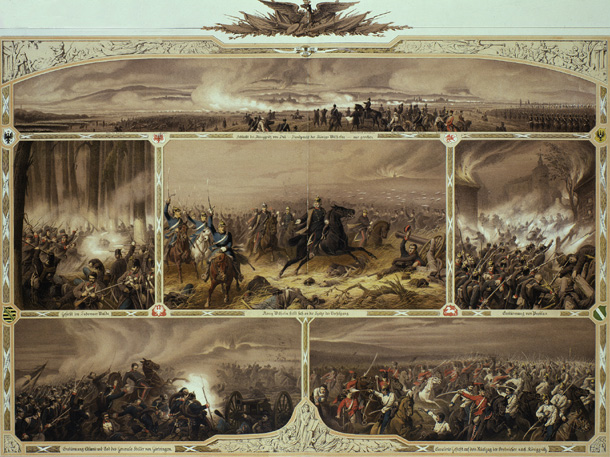
The Austrian army of 215,000 faced the Prussian Army of the Elbe (39,000) and First Army (85,000) on 3 July. The Austrian infantry was partially fortified and supported by cavalry in the rear and artillery units with firing range across hilly, wooded terrain. The battle began at dawn in subsiding rain and mist as Prussia took its position west of the Bystřice River. Shortly before 8 a.m., the Austrian artillery opened fire, pinning down the Prussian right flank under Herwarth von Bittenfeld. The Saxons on the Austrian left fell back in good order, and proceeded to rain down fire on the advancing Prussian right from higher ground. Herwarth von Bittenfeld hesitated to order a full attack, and instead the advance guard of seven battalions, under Brig. General von Schöler pulled back to the river around 10:00 and took a defensive stance.
The Prussian center, with the Prussian 7th Division under General Eduard Friedrich Karl von Fransecky, having secured the Prussian rear earlier, led the advance into Swiep Forest, where it was met by two Austrian corps. The 7th Division had to both clear out the forest, and cover the Prussian left until the Second Army, under the crown prince, arrived. The Prussians methodically cleared the villages of Austrian defenders. King Wilhelm I of Prussia ordered the First Army across the river to support Fransecky. Sadowa was captured, but a fierce battle ensued in a nearby forest. The Austrian artillery held off the Prussians by firing into the smoke of the Prussian advance. The Prussians were slowed, and although the river was easy to wade, transporting artillery across it was extremely difficult. The Prussian attack was halted as the advancing Prussian 8th and 4th Divisions were cut down by the Austrian artillery as soon as they emerged from the smoke. However, the Austrian leader, Benedek, refused to call for a cavalry charge which later commentators have argued might have won the battle. Reserve units were deployed at noon, but the outcome of the battle was still uncertain and Prussian commanders anxiously waited for the crown prince.

No comments:
Post a Comment